

I keep coming back to a single thought: we almost threw it away.
In 1901, a team of Greek sponge divers found a shipwreck off the coast of Antikythera, a small island between Crete and mainland Greece. They pulled up statues, pottery, jewelry. Standard archaeological treasure. Among the artifacts was a corroded lump of bronze and wood, so unremarkable that it sat in a museum storage room for months before anyone looked closely.
When they finally did, they found gears inside. Dozens of them. Interlocking, precisely cut, arranged in a configuration that would have made sense in a 19th-century clockmaker’s workshop. Except this device had been underwater since roughly 60 BCE.
The Antikythera mechanism, as it’s now called, is often described as the world’s first analog computer. But that description doesn’t quite capture what bothers me about it. It’s not just that ancient Greeks built something technologically impressive. It’s that they built something we didn’t know was possible until we found the physical proof sitting in front of us.
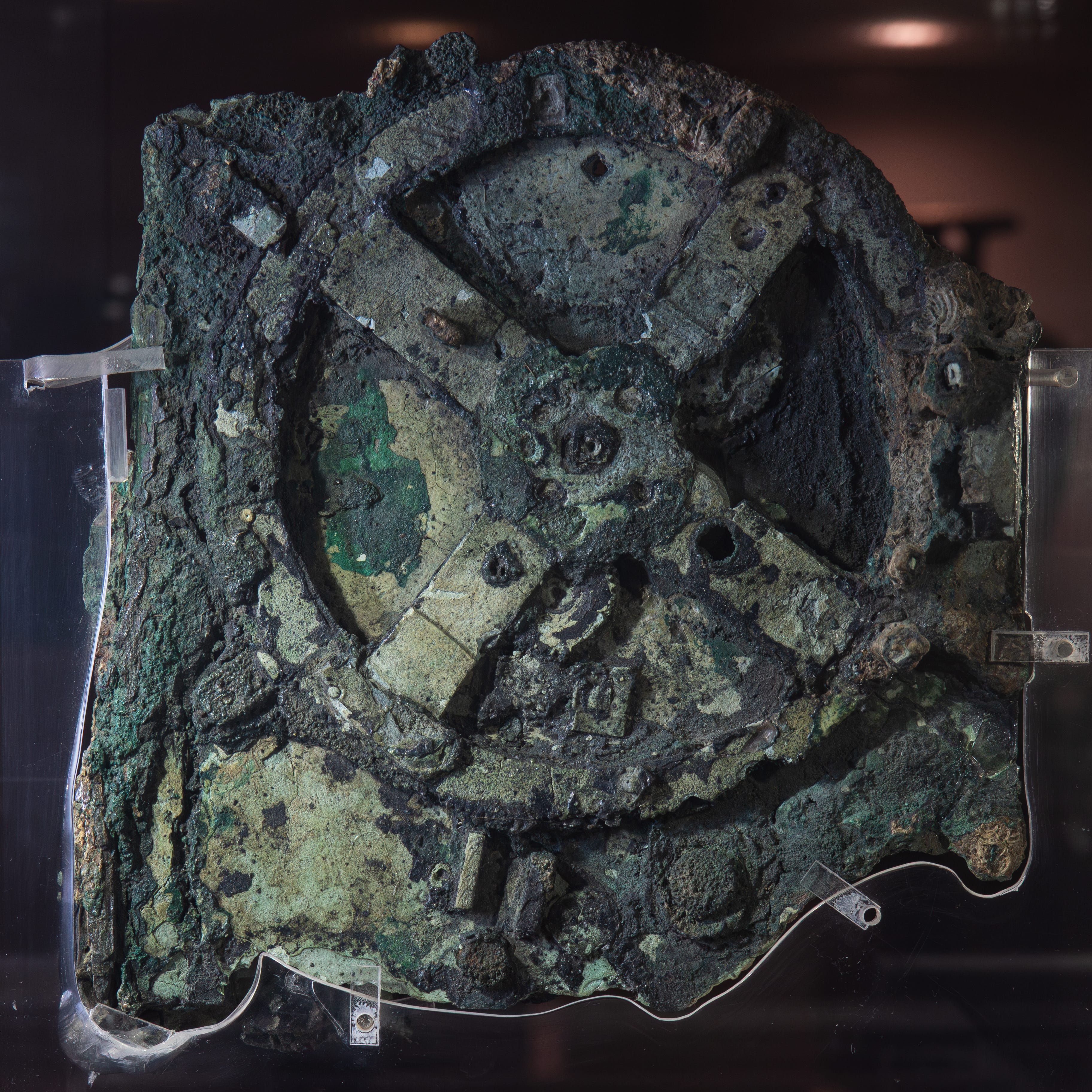
The Antikythera mechanism
(Image license: CC BY 4.0)
What It Actually Did
The mechanism wasn’t decorative. It was functional, sophisticated, and built for a specific purpose: astronomical calculation.
When you turned a hand crank on the side, a complex system of at least 30 bronze gears would calculate and display the positions of the sun, moon, and planets. It could predict eclipses. It tracked the Olympic Games cycle. It accounted for the Moon’s elliptical orbit using an offset gear system that wouldn’t appear again in human technology until medieval Islamic astronomy, over a thousand years later.
The gear work is precise enough that researchers needed X-ray computed tomography to fully map it. Some gears have teeth smaller than a millimeter. The differential gearing, a technique we associate with modern automobile transmissions, is right there in the mechanism’s design.
Here’s what gets me: this wasn’t a prototype. The sophistication suggests a mature technology, something refined over generations. Which means the Antikythera mechanism probably wasn’t the first of its kind. It was just the only one that survived.
The Part That Doesn’t Add Up
If this technology existed in the first century BCE, why don’t we have more evidence of it?
We have extensive Greek and Roman texts on astronomy, mathematics, engineering. We know they were obsessed with celestial mechanics. But descriptions of devices like this? Essentially nonexistent. There’s one vague passage in Cicero describing something similar, and a few references to spheres built by Archimedes, but nothing remotely detailed enough to reconstruct what we’re seeing in the Antikythera mechanism.
The standard explanation is that mechanical devices weren’t considered worth writing about in detail. Theoretical knowledge was prestigious; hands-on craft work was for laborers. So the people who could build these mechanisms weren’t the people writing the texts that survived.
Maybe. But I think there’s something else worth considering.
Bronze was valuable. Really valuable. When the Roman Empire collapsed and trade networks broke down, bronze objects were melted down for their raw material. Statues, tools, scientific instruments, all thrown into furnaces to make coins or weapons or whatever was needed for immediate survival. An intricate gear mechanism would have been worth more as scrap metal than as a confusing old machine no one remembered how to use.
We didn’t lose the knowledge of how to build these devices because people forgot. We lost it because the physical objects were systematically destroyed, and without the objects to study, the knowledge became abstract, then theoretical, then myth, then nothing.
What This Means for Everything Else
I’ve been thinking about how we understand historical technological progress. We tend to imagine it as a steady upward line. Older civilizations had simpler tools. Newer civilizations developed more complex ones. Progress.
The Antikythera mechanism breaks that narrative. It’s proof that ancient societies reached levels of technological refinement in specific domains that we didn’t think possible. And if it happened once, in one area, what else are we wrong about?
There’s a concept in archaeology called “absence of evidence is not evidence of absence,” but we don’t always follow it. We assume that if we haven’t found something, it probably didn’t exist. But the Antikythera mechanism sat ignored in a museum for months because no one was looking for it. How many other corroded lumps have we dismissed?
I’m not suggesting ancient Greeks had smartphones or whatever nonsense the pseudoarchaeology crowd wants to claim. I’m saying that our picture of what they could do is built on incomplete evidence, and every time we find something like this, we have to revise upward.
The question that keeps me up: what else was lost?
The Psychological Angle
There’s a cognitive bias called the “availability heuristic.” We judge the likelihood of something based on how easily we can recall examples. If we’ve never seen evidence of advanced ancient technology, we assume it was rare or nonexistent.
But the survival of artifacts is a filtering process, not a representative sample. Organic materials decay. Metal gets recycled. Stone lasts, which is why we have so many stone tools and temples, and relatively few wooden machines or textile technologies. Our view of ancient civilizations is skewed toward what survives, not what existed.
The Antikythera mechanism survived because it was on a shipwreck, sealed away from the economic pressures that would have melted it down. It’s a data point that slipped through the filter by accident.
When I think about Bronze Age metallurgy, or Roman concrete that still outlasts modern materials, or medieval astronomical instruments, I wonder what the actual cutting edge looked like. Not the average. The peak. Because the Antikythera mechanism clearly wasn’t average.
What I Can’t Explain
Here’s the part that still bothers me after reading dozens of papers on this thing: if the knowledge to build gear mechanisms this sophisticated existed, why did it disappear so completely?
Technology usually spreads. A useful innovation gets copied, adapted, improved. Even if the original context is lost, the technique often survives in some form. But the specific gear-cutting and assembly methods used in the Antikythera mechanism? Gone. For over a millennium, no one in Europe was building anything comparable.
Some researchers think the knowledge was kept deliberately restricted, maybe within a small guild of craftsmen who didn’t write things down. Others argue it was dependent on a specific economic and social context that collapsed and couldn’t be rebuilt.
I don’t find either explanation fully satisfying. But I also don’t have a better one.
Why This Matters Now
The original is in the National Archaeological Museum, and even in person, it doesn’t look like much. Greenish, corroded, broken into dozens of pieces.
But I keep thinking about the divers who found it, the researchers who ignored it, the decades it took before anyone understood what they were looking at. We nearly lost it twice: once when the ship sank, and again when we didn’t recognize what we had.
It makes me wonder what we’re not recognizing now. What assumptions we’re making about the past, or about other cultures, or about the limits of what’s possible without modern industrial infrastructure.
The Antikythera mechanism isn’t just a cool historical artifact. It’s a reminder that absence of evidence can hide entire categories of human achievement. That our narratives about progress and civilization might be built on a very incomplete picture. That we’ve lost more than we know.
And if we’ve lost it once, we could lose it again.
I don’t have a tidy conclusion here. I’m still working through what this means. But if you’re interested in this kind of thing, if you want to follow along while I dig into other historical mysteries that don’t fit the standard narratives, you can subscribe. I’m trying to look at these questions differently than the typical history documentary approach. More questions, less certainty, and a lot of sitting in libraries looking at things that don’t make sense.
Let me know what you think. What else do you think we’ve lost without realizing it?
One thing I've considered from inside this bubble you're observing; I'm one of the last of a dying breed of machinists. We made scientific research tools, seafloor penetrating core samplers with Acme-threaded segments, ice-shaving machines to separate segments of ice cores without melting, nitric oxide containment systems for atmospheric research, dynamic testbed structures for torpedoes and later for electric motors, gear ausrolling tools, the list seems endless, twenty-two years of just that for me alone, and all of it without the assists of computer numerical control. We invented ways to machine what was needed; the ultrasonic array to be used to scan the reactor core at TMI, I and two others made, overnight. I see machinists coming to be now, they know nothing of any of that, and no one cares. It dies with me.
Now multiply my short life times the billions who've passed, through the milennia. Yes, man will always have lost more than he knows. Far, far more.
Fascinating, well-written article. Thanks!
I've read nothing else about this device; your account raises some questions that may have already been answered elsewhere. Based on what's visible and what has been revealed through imagery, has any attempt been made to build a working duplicate of this machine? Since it was recovered by laypersons, not archaeologists who would have noted and recorded its precise locational context within the shipwreck, could it be that it was lost many centuries later and coincidentally landed among the debris of the earlier archaeological site? Has radiocarbon dating of a sample of the wood been attempted?